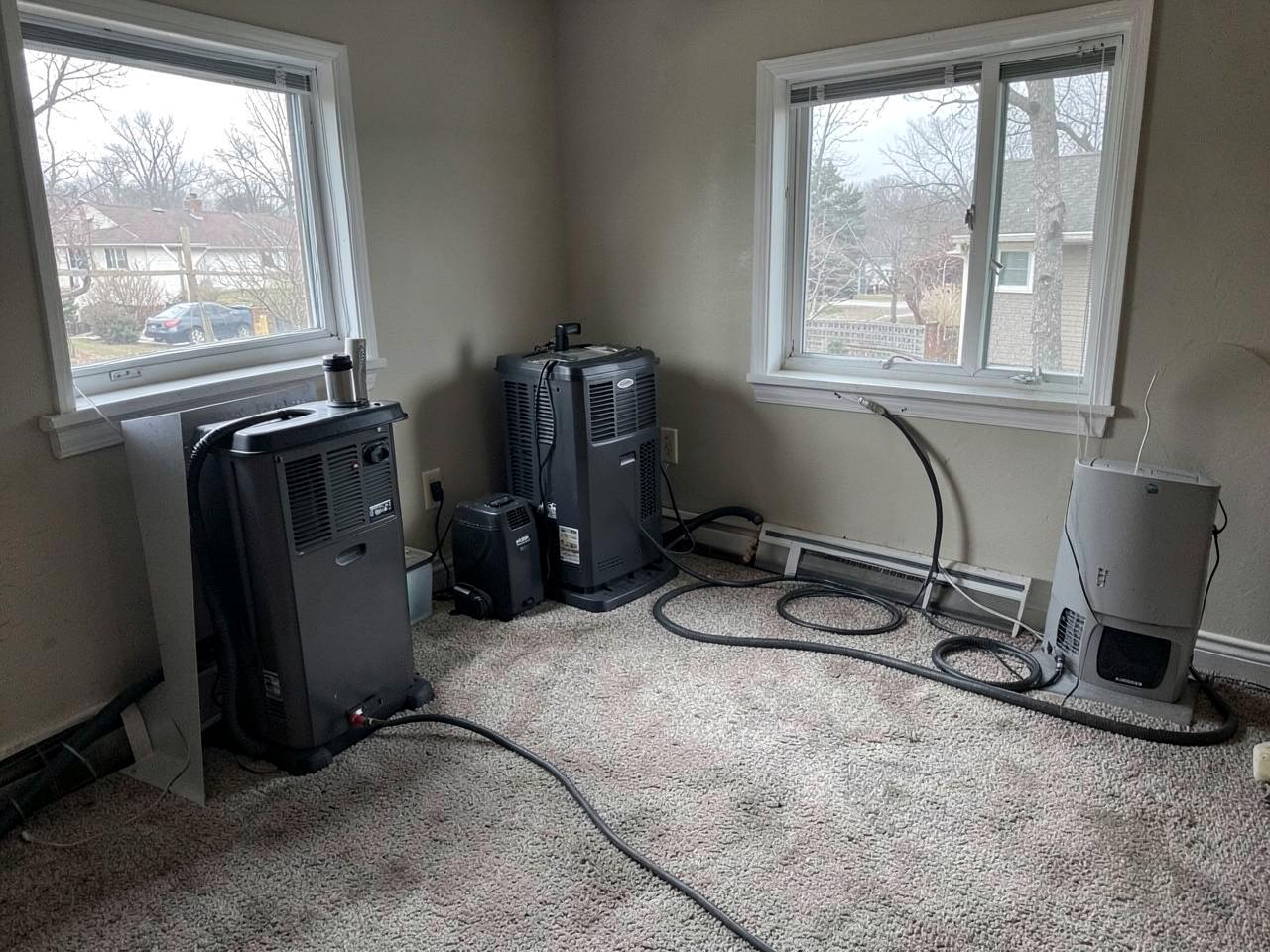
How structural drying works
Drying depends on three factors: air movement across wet surfaces, removal of moisture from the air, and temperature. Air movers accelerate evaporation from walls, floors and cavities. Dehumidifiers capture that moisture from the air so it doesn't simply settle back into cooler surfaces. The balance between the two is adjusted based on the size of the space and the moisture readings.
- Air movers positioned to sweep air across wet floors and along walls.
- Refrigerant or desiccant dehumidifiers sized for the volume of the space.
- Cavity drying by removing baseboards, drilling small holes or opening sections of drywall where needed.
- Daily moisture readings and equipment adjustment until dry standards are met.
Materials that need careful drying
- Drywall and plaster, which wick water upward well above the visible line.
- Hardwood flooring, which cups and buckles if dried too quickly or not enough.
- Subfloor and underlay beneath laminate, tile and vinyl.
- Concrete slabs and block walls, which hold moisture for extended periods.
- Insulation inside walls and ceilings.
Signs that a space was never fully dried
- Paint that bubbles or peels weeks after a leak was 'fixed'.
- Baseboards that swell or pull away from the wall.
- A musty odour that persists in a room or closet.
- Recurring staining on ceilings or walls.
Our drying process
Drying follows water extraction. We map moisture across the affected area with meters, set equipment based on that map, then return to take readings and adjust placement. Drying is complete when each material reaches its target moisture content, which we compare against unaffected areas of the same building. Only then is equipment removed and rebuilding scheduled.
Why professional drying matters
Household fans and a portable dehumidifier can dry surface moisture, but they cannot move enough air or capture enough moisture to dry framing, subfloors and cavities before deterioration begins. Professional drying is faster, monitored and verifiable, which is what allows drywall and flooring to be saved rather than replaced, and what prevents additional moisture damage after the visible repair is done.
Why choose Water Damage Mississauga
- Equipment matched to the size of the loss, from a single closet to a commercial floor.
- Moisture readings recorded and shared, so you can see progress.
- Cavity drying techniques that save finishes where possible.
- Part of a complete water damage restoration service when repairs are needed.
Structural drying across Mississauga
We dry properties throughout Mississauga, from century homes in Streetsville and Port Credit with plaster walls and plank subfloors, to modern builds in Churchill Meadows with engineered flooring and spray-foam insulation. Each construction type dries differently, and the equipment plan reflects that.
Frequently asked questions
How long does structural drying take?
Most residential jobs take three to five days, with heavier losses or dense materials like hardwood and concrete taking longer. Readings, not a fixed number of days, determine when equipment comes out.
Is the drying equipment loud?
Air movers and dehumidifiers do generate noise, similar to a loud fan. Equipment needs to run continuously to be effective, so we discuss placement to minimize disruption.
Can you dry inside walls without removing the drywall?
Often, yes. Removing baseboards and drilling small vent holes allows air to move through the cavity. Where insulation is saturated or the water was contaminated, drywall is removed instead.
This service is part of our complete water damage restoration in Mississauga.